THE BLACK FILE
RECORD + HYPOTHESIS1951 · SOUND MODULATION
No voice was recorded. One memo proposed drawing it instead.
What if the samples were gathered for more than resemblance? What if they were meant to deliver a sentence the person had never spoken, in the voice everyone trusted?
In 1951, a proposal sent to the CIA director said a voice could be made by drawing notches along film. It was not a success report. How far can The Margin Editorial Desk read into that conditional?
0–60 SECONDS / READ THIS FIRST
The case and the claim, up front
- What was observed
Its writer attached a description and simplified sketches of new theories about making and modifying sound, developed as a hobby.
- Which way the result moved
Its writer believed those variations could be made by hand and expected listeners familiar with the voice to believe the person was speaking.
- What remains unproved
The memo does not prove a successful test or operational use.
Open the full articleClose the full articleOpen the unresolved question, sources, and countercase+
The record
On October 12, 1951, a memo titled “Sound Modulation” was addressed to the Director of Central Intelligence. Its writer attached a description and simplified sketches of new theories about making and modifying sound, developed as a hobby.
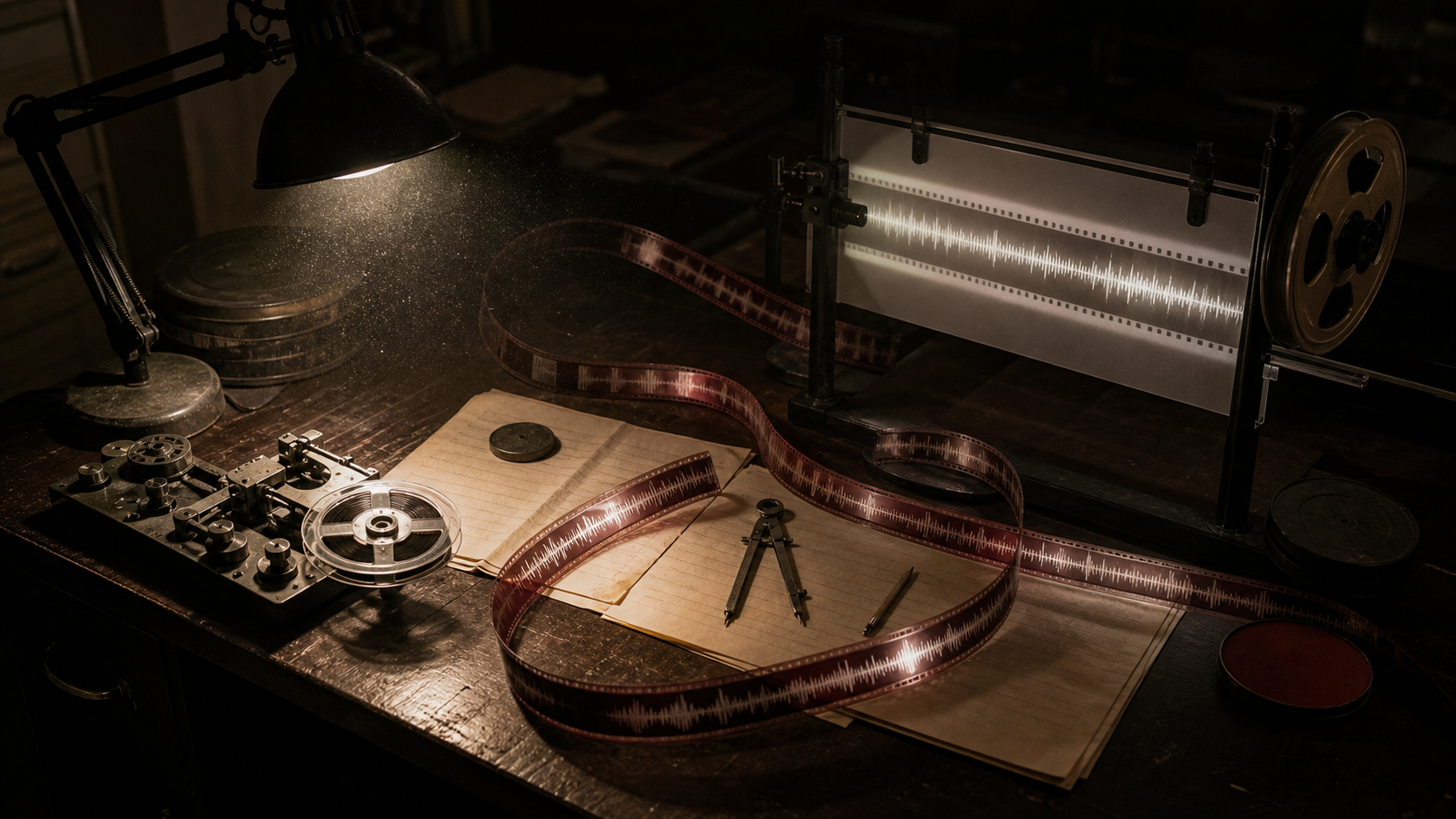
The writer proposed drawing serrations on film to produce a desired sound or line of speech. After samples of one person's speech were analyzed, the memo said, a sound strip could be made to say anything while retaining that person's pronunciation characteristics.
The memo said different voices produced different light patterns for the same word or syllable. Its writer believed those variations could be made by hand and expected listeners familiar with the voice to believe the person was speaking.
If the theory proved practical, the writer said, its value in peace and war would be obvious. The memo asked whether the CIA was interested. It contains no report of a successful test, agency approval, a prototype or operational use.
The turn
A recording begins with something a person actually said. This proposal began with a shape drawn on film. The voice moved from being a trace of an event to a surface that might be edited.
The proposal's strongest claim was not a performance figure. It was a prediction about belief: that a listener might misidentify who had spoken.
Three possibilities
First possibility. The proposal's first invention was not a device but a way of seeing a voice: as a pattern that could be drawn.
Second possibility. A convincing pattern might turn speech that never happened into an event a listener remembered as real.
Third possibility. Success may not have required a perfect imitation. A few seconds of mistaken identity might have been enough.
The editorial conclusion
The record stops here. The memo reaches as far as sound film and a listener's belief. What follows belongs to The Margin Editorial Desk.
What if the samples were gathered for more than resemblance? What if they were meant to deliver a sentence the person had never spoken, in the voice everyone trusted?
My conclusion? Aliens.
The case against it
The memo does not prove a successful test or operational use. Its writer made practicality a condition, and the document does not show approval for follow-up research.
Film sound, voice analysis and manual synthesis are enough to explain the proposal. The simplest reading is that an ambitious technical idea survived in an agency file.
What the record cannot tell us
The public memo does not establish how the attachment was reviewed, whether a prototype was built or who submitted the proposal.
Without later records, we cannot know whether the CIA replied, whether any listener was tested or whether the manual method was workable in 1951.
The writer proposed drawing the proper serrations on film to make desired speech, then using samples of one person's voice to reproduce that person's pronunciation characteristics.
The memo said the same word or syllable leaves a different light pattern for each voice, and claimed those variations could be made by hand after enough samples were studied.
The writer said the theory would have value in peace and war if practical, asked whether the CIA was interested, and requested a negative reply if it was not.
Not the CIA's original file · Open preserved transcript, paragraphs 1–7 ↗

Corrections
There are no public corrections at this time.
Translation and reporting Mara Venn / Fact-checking Gideon Park / Implications Imani Sloane / Boundaries Ruth Alder / Copy Jonah Reed / Reader review Mae Bell / Production Theo March / Publisher Ada Mercer